The Romani, the word isn't even found in my computer's dictionary, the people however can be evoked anywhere you look. When you look at the culture itself it's hard to see why, they keep mostly to themselves with their historically nomadic habits and their quiet nature. The way they have lived and died would almost be sure to have been rushed over by the sands of time and snuffed out, considering they were a large target for the Nazis in World War II. A personal hatred of Adolf Hitler's the Gypsy was so far spread and immersed in their culture that perhaps he found some personal threat by a culture so rich in it's own history and ways. An event of such horrific brutality that would make any Romani of age shudder and bless themselves is the occurrence of Porajmos or “The Devouring” in the Roma language. This event in and of itself had claimed over two-hundred thousand lives, enough to drive any population of any race down a considerable amount. The tragedy that befell the Romani people has been sadly hushed up and left for forgotten in comparison with the Holocaust which took more than six million European Jewish lives. In reverence of this horrendous event there were massacres all across Europe that made many orphans, widows and widowers and the tragedy lives on in the hearts of the world.
The gypsy is often seen as a whimsical creature of fantasy, thieves and rogues, historically speaking this is partly correct. Generally speaking however this is propaganda mostly started in World War II along with the rat-nosed illustrations of Jewish people like any other tasteless portrayal of bigoted hatred there was little to no truth in the pictations of race when the Nazi regime was concerned. The Roma people unfortunately have forever been thrown to the dogs yet still strive to exist, strive to forever remain who they are and their honor and pride is such that this wish has carried them for more than a thousand years. Their strength is such to be admired and respected from small caravans of migrants to large camps of Roma their past is as mysterious as the people, it is known however that they split into several directions when migrating around Europe. Originating from around South Asia; they migrated between England, Finland, France, Hungary, Turkey, Portugal, Russia, Scotland, Spain, and Sweden ultimately migrating into the Americas and onward.
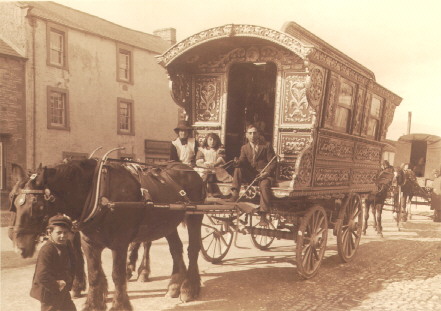
In the images accompanied is shown the progression of the Gypsy people, from a people of migratory nature to a people of prideful exhibition. Their history is one of intrigue for members of historical reenactment guilds, their dress and colorful spectrum of lives allow volumes to be spoken for them. Improvisational actors portray the lives and spirit of the Roma people, a very beautiful people intricate in every detail of their being, telling stories of what was once a great nation that was divided and spread into the very corners of the earth to be consumed by civilization. Like the Native American tribes their custom was a unique one that summons forth more fantastical imagery than realistic fact. The Gypsy is a creature of wondrous intent their mystery and solitude drives our imaginations to places of incredible fascination. Philosophically speaking the Roma are like Atlantians, spread out and populated the earth with their culture and stories but eventually enveloped by the general populous becoming nothing more than myth. So, the question is brought forth, if we are to glorify the image of the fantastical Gypsy does it become a creature of wonderment, or will it help preserve the image of the Roma people? The Romani? I suppose the best answer for this question is what is love? Truly why do we love, through this we realize that the Roma are a people of love. As long as the culture is loved and the culture loves back the Roma will never die.
------------------------------
Images can be found at these sites.
southfloridadaily.com/wp-content/uploads/2007/04/gypsy.jpg
www.sacred-texts.com/neu/roma/img/roma.jpg
www.mlahanas.de/greece/history/images/romaaetolia.jpg
media-2.web.britannica.com/eb-media/15/90015-004-bf7ca0aa.jpg
www.serpukhov.su/museum/yarosh_gypsy.jpg




Subscribe to:
Post Comments (Atom)
1 comment:
Post a Comment